Observe. Relax. Release.
Nafas means breath in Farsi. The Signal Method is the practice: how you meet what rises in you, and find your way back to center a little faster each time.
A trigger becomes a reaction faster than thought.
Something happens, and before you are aware of anything, the limbic system has already flagged it, safe or unsafe, reading this moment against everything you have ever stored. The verdict drops into the body through the nervous system, which answers in chemistry you feel as tightness, heat, a racing heart. The body reports back up the vagus nerve to the mind, which wraps the raw signal in a story, and only now do you feel a distinct emotion. All of it happened on its own, in a fraction of a second, with no say from you.
Then something in you moves to protect you from what you feel, and the old, practiced reaction fires with no pause between the feeling and the response. This is the loop. It is not a flaw, it is a system running exactly as it was trained to, and a trained system can be retrained. That felt moment is also the first place anything voluntary becomes possible. Every trigger carries you to the same place: a fork.
Everything before the fork is automatic. The fork is not.
The fork is the one moment in the whole chain where something voluntary is possible. Everything up to it fired on its own. Here, for a breath, there is a choice, though most of the time it passes unfelt, because it goes by so fast.
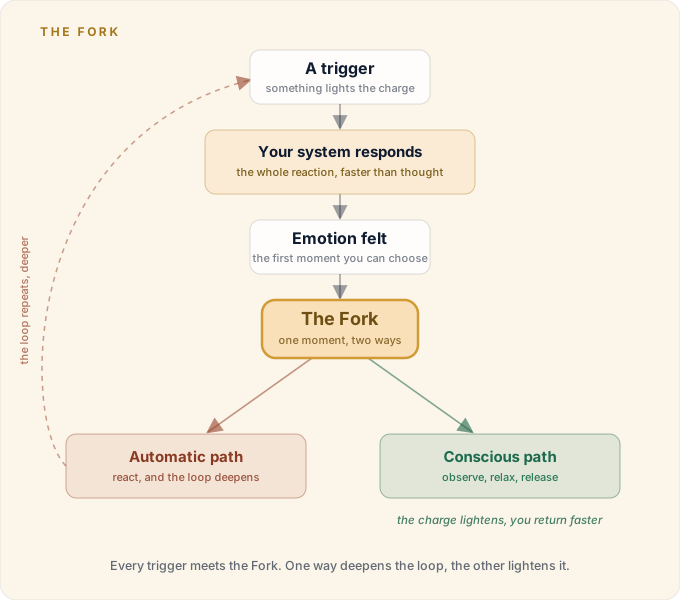
What you return to, each time you take the second path, is a center that was never really lost, your own heart.
That gap, the room where choice lives, can be widened. The rest of the method is how you widen it.
Look again at the loop. Four systems inside it can be trained.
The loop is not a flaw. It is a trained system, and a trained system can be retrained. Look at where it runs, and four systems come into view. Each one changes a different part of the loop, and each can be strengthened at its own pace, with its own practices.
You do not work them one at a time. You work all four together, with your starting point as the emphasis. As they build, a steadier capacity grows underneath: more room at the fork, more choice, more of you available when it matters. Here is what you do with it.
You do not fight the feeling, and you do not follow it. You stay.
At the fork, everything in you wants to react, to fix it, explain it away, or reach for whatever makes the feeling stop. The conscious path is none of those. It is staying with what is here long enough to let it move through. To choose it is to stop abandoning yourself.
Notice what is happening before it runs you. A thought is a thought, a pattern is a pattern, and you are the one who can see it. In that small gap, the feeling can land in the body instead of becoming a story. This is the Mind at work.
Soften around what you find, instead of bracing against it. This is where the breath comes in, a slow exhale telling the body it is safe faster than any thought can. Nafas. The body coming back online is what makes the rest possible.
Let the energy finish. A feeling that is met instead of fought completes its cycle and passes, sometimes as a slow breath, a warmth, a few quiet tears. What is felt all the way through does not have to be carried.
None of this stays abstract. The Signal Method is practice-based, drawing on a deep library. Meditation, breath, somatic work, and journaling are a few of many, and part of the work is your coach choosing the ones that fit where you are now, and changing them as you grow.
That library is not improvised. The Signal Method draws from internal family systems therapy, somatic work, polyvagal theory, breathwork, neuroscience, shadow work, and contemplative practice, built into a single framework rather than a menu you pick from. What holds it together is one question: where exactly is your system breaking down, and what does it need? That is what makes the work precise instead of general.
Each time you do this, the charge that fired grows a little lighter, and you come back to yourself a little faster. Progress here is not how calm you stay, it is how quickly you come back.
You do not reach for these. You grow into them.
The states on this cone are not a ladder you climb by trying. They are byproducts. As you work the four domains and practice the three movements, a capacity grows underneath, and that growing capacity is what carries you higher. No one starts at the top, and no one has to. The wide base is where everyone begins.
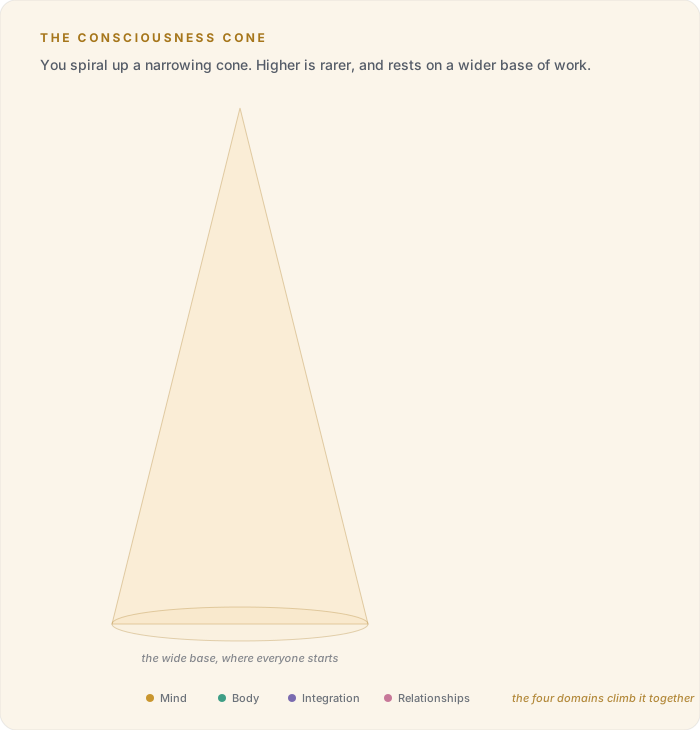
You do not have to live at the tip. The point is that, over time, more of your life is met from higher up, with more room and more choice, until the split between you and your experience thins and the right response simply arises. And the higher you climb, the tighter the loops become, the contraction shallower, the return faster.
Built for you, and walked with you.
Generic advice cannot replace a practice built for your actual life. We start with a clear picture of where you are across the four domains, build a plan from it, and adjust as you change. You are not handed a program and left alone with it.
And the relationship itself is part of the healing. A steady, genuinely present companion who does not need you to be any different than you are is one of the ways the nervous system learns, through repeated experience, that closeness is safe.
You hold the truth of your own heart. We hold the map.
Where are you, really?
A short, honest assessment. Fourteen questions, a few quiet minutes.
Find out where you are